Barley Dish with Buttermilk and Dill
Creating a healthful meal
A post by Stella, translated from German in June 2026
I found the following note in Sigrid Königseder’s recipe notes: “Barley with buttermilk and dill. Pour 3.5 times the amount of boiling water over the barley, or bring it to a brief boil. Then let it soak in the oven at 120°C for about 1 hour. Remove the barley from the oven and season with salt, buttermilk, balsamic vinegar, and plenty of dill.”
- Creating a healthful meal
- How to cook hulless barley
- What quality do I want to bring out with this menu?
- Reflections on the properties of barley
- Health Benefits of Barley’s Mucilage-Forming Properties
- According to scientific research, beta-glucans from barley have the following properties:
- Mucus formation from an anthroposofical perspective
- A meal with cleansing and detoxification effect
- Do you want to get to know more about this kind of holistic cooking?
How to cook hulless barley
To ensure the best possible digestibility, I followed these steps when cooking the barley: Soak 70 g of barley per person in 3.5 to 4 times the amount of water (depending on the quality of the barley; use 4 times the amount for hulless barley) the night before.
The next day, bring the barley to a boil in the soaking water and let it simmer gently for about an hour, so that there is still enough liquid to allow the barley grains to release their mucilage. After the initial boil, keep it warm for at least 45–60 minutes—for example, wrapped in a blanket—and let the mucilage form. Bringing it to a boil again afterward causes more mucilage to form.
Now let the barley cool enough so that the buttermilk (about one-third of the barley’s raw weight) can be added to coat the grains without curdling. Then season with plenty of dill—fresh or dried—along with a little light balsamic vinegar, salt, and olive oil. Let it rest again, or allow it to absorb the liquid. Stir gently before serving.
What quality do I want to bring out with this menu?
Through the proper cooking process, the barley’s ability to form mucilage should be highlighted as a quality that promotes health.
The qualities of warmth and light that are naturally present in barley, buttermilk, dill, and vinegar should be elevated to form a new, harmonious whole in the final dish.
Reflections on the properties of barley
Heinz Grill describes the detoxifying, cleansing effect of barley on the body: “The light ether in barley acts on the metabolism and, from there, on the mind.” In the book Die Heilkraft der Seele (The healing power of the soul), also by Heinz Grill, the following statement can be found: “The light ether acts centripetally, on a large scale from the cosmos to the Earth. In this direction of action—from top to bottom—it promotes, for example, healthy excretory processes.”
Udo Renzenbrink writes in Die sieben Getreide (The seven cereals): “The mucilage produced by barley points to its importance in dietetics. The active properties of barley are fully contained in the mucilage, for a plant that produces mucilage pours its entire essence into it.”
References to the medical use of barley mucilage can be found in the writings of Hippocrates, particularly regarding the use of ptisana. “In the Hippocratic treatise On Diet in Acute Diseases, for example, the importance of barley preparations is emphasized, as well as the possibility of various methods of application,” reports the historian of chemistry Ernst Darmstedter (1877–1932).
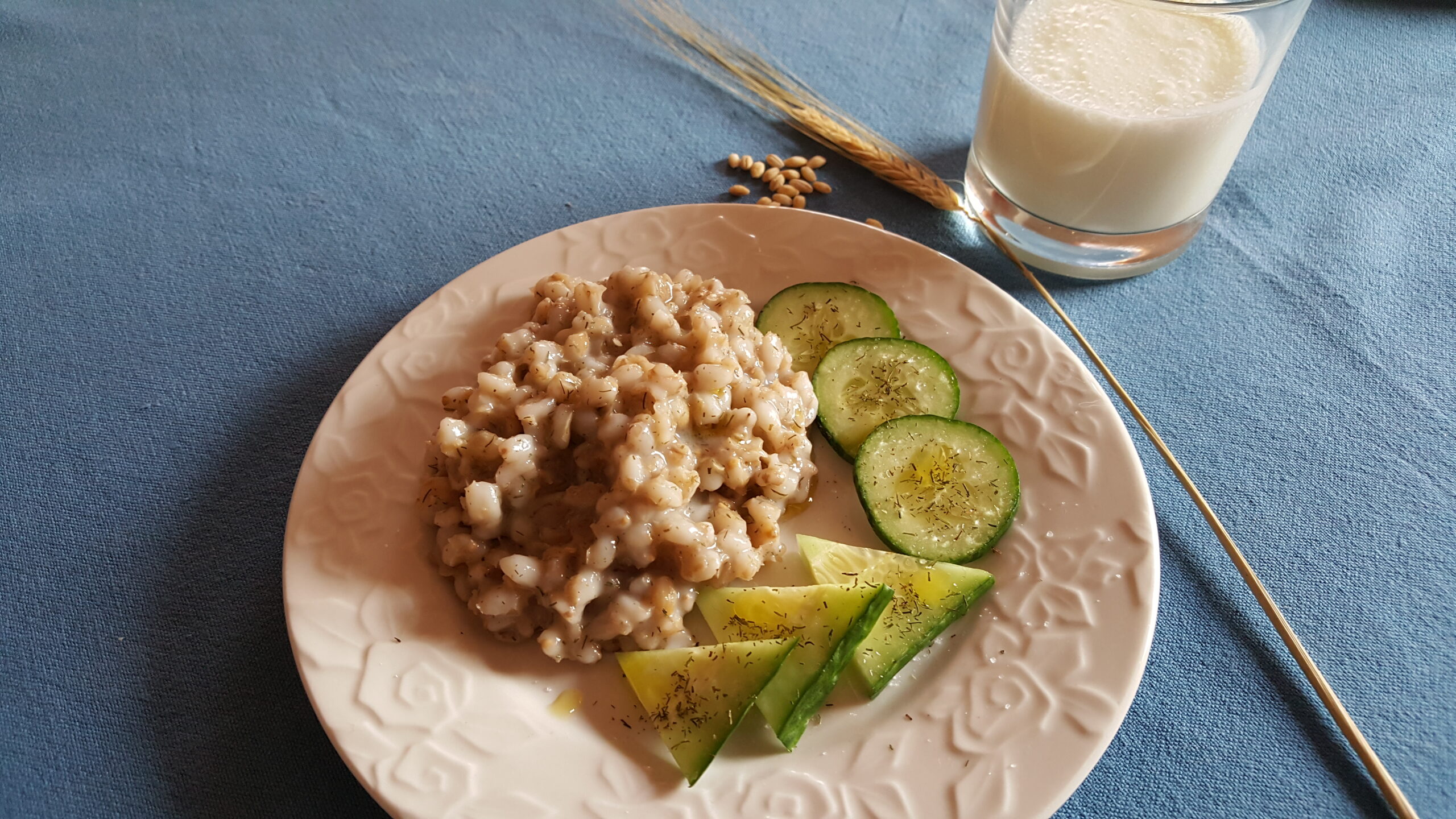
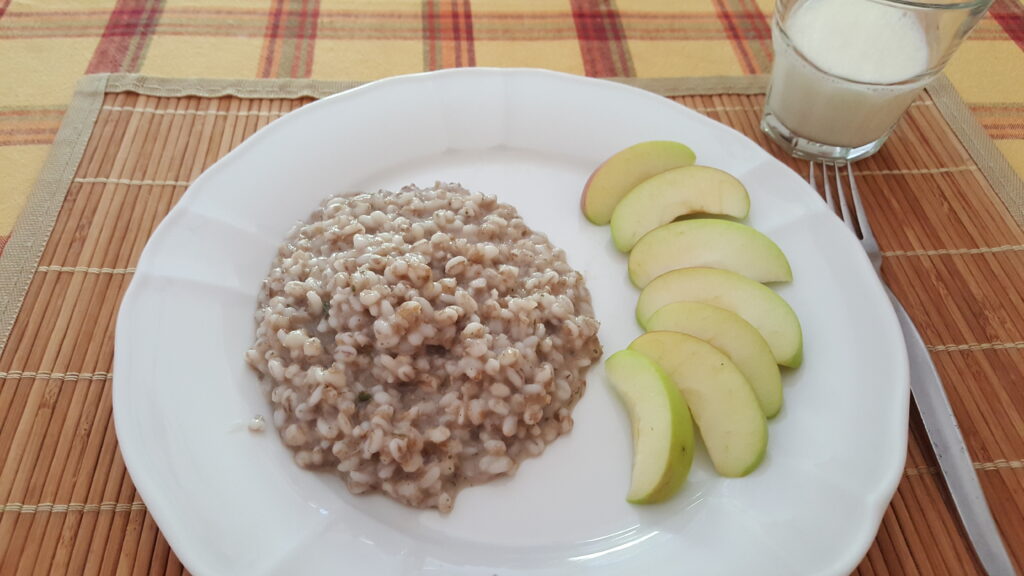
Now, you may have a look at the main photo on the top of this article: The light, pale yellow/beige, glossy, well-plumped barley grains are visible individually, yet bound together as a single unit and gently coated in an emulsion of barley slime and buttermilk. Soft to the bite, the flavor of dill is distinctly noticeable, accompanied by the mild acidity of the vinegar.
Mildly seasoned cucumber, cut into various shapes, shines in inviting shades of green, complementing and rounding out a meal that refreshes the senses and purifies the body.
The buttermilk drink rounds out the dish with its easily digestible protein content
Health Benefits of Barley’s Mucilage-Forming Properties
The health-promoting effects of barley mucilage are primarily attributed to its high beta-glucan content. Beta-glucan is a water-soluble complex carbohydrate, a dietary fiber that accounts for about 4.8% of barley, 4.5% of oats, but only 0.8% of wheat by comparison.
While this soluble dietary fiber in the oat kernel is found mainly in the outer layer of the endosperm (subaleurone layer) and in the outer layers of the kernel (aleurone layer), in the barley kernel it is concentrated 27% in the outer layers and, primarily, 73% in the interior of the kernel (endosperm).
According to scientific research, beta-glucans from barley have the following properties:
Cholesterol-lowering effect:
Beta-glucan has the ability to lower cholesterol levels. Beta-glucans from oats and barley can reduce total and LDL cholesterol levels in the blood. Beta-glucan from barley mucilage has a cleansing effect because it acts as a soluble dietary fiber and binds cholesterol and bile acids in the intestine, leading to their excretion and lowering LDL cholesterol levels.
Regulation of blood sugar levels:
Beta-glucan has the ability to regulate blood sugar levels. Beta-glucans slow the absorption of glucose from the intestines into the bloodstream, resulting in a smaller rise in blood sugar levels after meals and reduced insulin secretion. This can be particularly beneficial for people with diabetes.
Strengthening the Immune System:
Beta-glucans from barley strengthen the immune system by activating immune cells such as macrophages and improving their function, which involves recognizing and neutralizing pathogens such as bacteria and viruses.
Promoting a healthy gut environment:
Beta-glucans from barley promote a healthy gut environment by acting as prebiotics and serving as food for beneficial gut bacteria. Barley beta-glucans are fermented by these bacteria in the human gut, as they are difficult or impossible for the human body to digest. This fermentation leads to the formation of short-chain fatty acids, which lower the pH level in the gut, creating an acidic environment that inhibits the growth of harmful bacteria and promotes the growth of beneficial bacteria.
Anti-inflammatory effect:
Short-chain fatty acids such as butyrate, which are produced through fermentation in the gut, have an anti-inflammatory effect and can therefore contribute to the treatment of chronic inflammatory bowel diseases.
Mucus formation from an anthroposofical perspective
Mucus production in plants is understood as a process that protects the plant and strengthens its resilience, for example, against external influences.
This property is viewed as a form of vitalization that can also be applied to humans to support their own healing powers.
Mucilage from barley has a soothing effect on inflamed mucous membranes and protects them from irritants, which promotes healing.
Based on his research, Udo Renzenbrink highlights the soothing effect of barley mucilage on acute irritation of the stomach and intestinal mucous membranes, even in patients with severe inflammation and ulceration. He also notes that the silica component of barley can have a beneficial effect on mucosal defects. In Die sieben Getreide, he explains that barley mucilage induces healing changes in the intestinal environment and binds and excretes toxic metabolic byproducts.
Other components of the dish
Cucumber
“Cucurbits are considered a remedy for both the liver and the kidneys. To a somewhat lesser extent, this healing effect—with its cleansing properties—also applies to the common cucumber.”
Buttermilk
Buttermilk has certain anticarcinogenic properties. At the same time, it is a dietary aid that protects the body from the buildup of waste products.
Dill
The essential oils contained in dill, particularly carvone and limonene, relax the intestinal muscles, stimulate digestion, reduce bloating and a feeling of fullness, and can have anti-inflammatory effects; its use can remove excess water from the body and stimulate the elimination of waste products. (Gewürzmuseum Hamburg) Udo Renzenbrink on dill: “The much-loved dill has a stronger warming effect than fennel, as it originates from the Orient and India. That is why dill is often used to season dishes that are naturally watery and cold.”
Vinegar
Diluted apple cider vinegar can stimulate the metabolism, aid digestion, and contribute to detoxification by promoting liver and kidney function and helping to eliminate toxins. (Christina Zacker, Carolin Bayer, Apfelessig, Heyne Verlag)
A meal with cleansing and detoxification effect
The main ingredients of this dish—barley, cucumber, buttermilk, dill, and vinegar—all share the ability to promote the body’s cleansing and detoxification through their diverse individual properties. Through expertise and dedication, the cook can transform these inherent qualities into a healing dish.
How does the cook infuse the food with qualities of warmth and light?
At the beginning of every successful endeavor lies a thought, an idea.
What do I want to promote? Based on my perception of the outside world.
What is needed, both generally and individually?
A clear mental visualization of the quality the cook wishes to promote, a concrete image of the finished meal (as described above for the barley dish), the individual steps and actions involved in the work, the harmonious interaction in the kitchen, and what the person eating this dish might ideally look like—all of this forms the best possible beginning, the first step even before preparation begins—and can thus serve as the foundation for warmth.
Mindfully maintaining the overall image of harmony, observing the cooking and preparation process (e.g., the transformation of the grain, the swelling, etc.), paying attention to the actions, and making necessary adjustments based on observation and perception (e.g., are the cucumber slices turning out the way I imagined them while cutting?)
Joyful exploration, getting to know the ingredients, pausing and observing, perceiving and weighing options, connecting with them, developing interest through engagement, and focusing on a (shared) goal allow unnecessary distractions to fade away and create space.
If this process takes place sufficiently in the cook’s actions, the heat and light etheric forces inherent in the foods can be released, and the cook creates additional qualities of warmth and light—both within themselves and in the food.
Do you want to get to know more about this kind of holistic cooking?
The Forum for Holistic Vegetarian Cooking Art offers you the possibility of an internship, from 3 to 10 days.