Barley and the Role of Humans in the Cooking Process
“Barley” was the topic of the video conference held by the Forum for Holistic Vegetarian Cooking Art on July 24, 2026. Fourteen participants from five countries attended. The next video conference will take place on Friday, August 21, 2026, at 8:00 p.m. The Telegram group “Holistic Vegetarian Cooking Art” is a public group dedicated to exploring the possibilities of a healing and aesthetic culinary art. If you would like to participate, please send an email to info[at]carmenkraus.com.
Humans as researchers-Does human research influence the cooking process?
This opening question elicited a wide range of responses. Grains have numerous healing properties, which is what makes them such an interesting food. If one looks beyond the known scientific phenomena and explores the mental and spiritual dimensions through a perspective enriched by spiritual insights, an ever-deeper connection to grains as a food emerges, and one becomes more flexible and imaginative in using them in the kitchen.
A “persistent commitment to the matter” (Monika)—from observing the plants to specifically pairing them with spices during preparation—also fosters psychological stability. For example, one first learns to truly perceive the grain and to develop a sense of the light energy associated with it. One discovers new aspects and develops an appreciation for this valuable food. Ultimately, one becomes capable of engaging in dialogue with representatives of other dietary traditions.
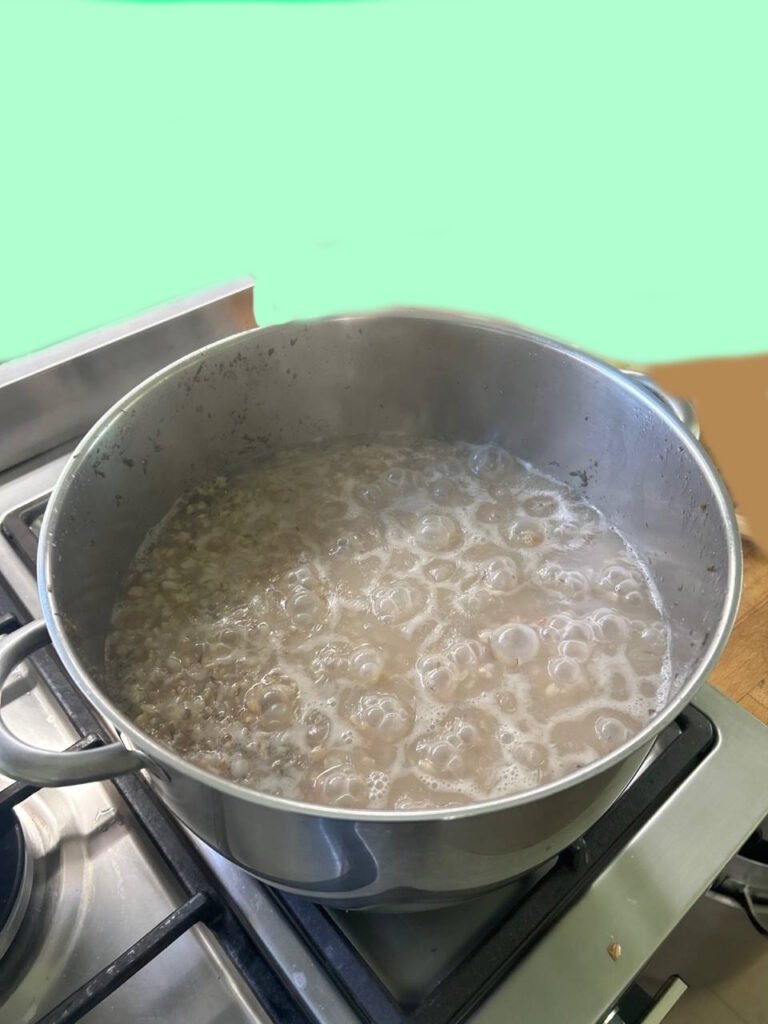
Typical foam formation at the start of the cooking process
Preparing Whole Barley
Basic Recipe for Four People
Soak 250 g of barley in 750 ml of water for at least 10 hours.
Then cook in the soaking water for 20 minutes.
To allow the grains to finish swelling at a lower temperature, either
let them sit on the turned-off stovetop or place them in the oven at
100°C for 30 minutes.
For the second cooking process, add another 250 ml of water and let it simmer gently until the mucilage is released and the grains are soft, no longer tasting “chewy.”
Add a little more water if needed.
Add 1 tsp dried sage or 2 tsp fresh, finely chopped sage about halfway through the cooking time.
At the end of the cooking time, stir 1 tsp salt and
1 tbsp olive oil into the barley and let it soak briefly.
What role does the person—the cook—play in the preparation process?
The cook can closely observe every stage of the barley’s preparation in the kitchen: At the outset, the grain is whole; after soaking, it becomes slightly plumper. During the first boil, it absorbs plenty of water, and as it continues to swell, it begins to burst open. During the second boiling, it turns inside out without dissolving into a shapeless mush. The individual grain remains visible and clearly discernible, while it forms a connection with the other grains through the cooking and gelatinization process.
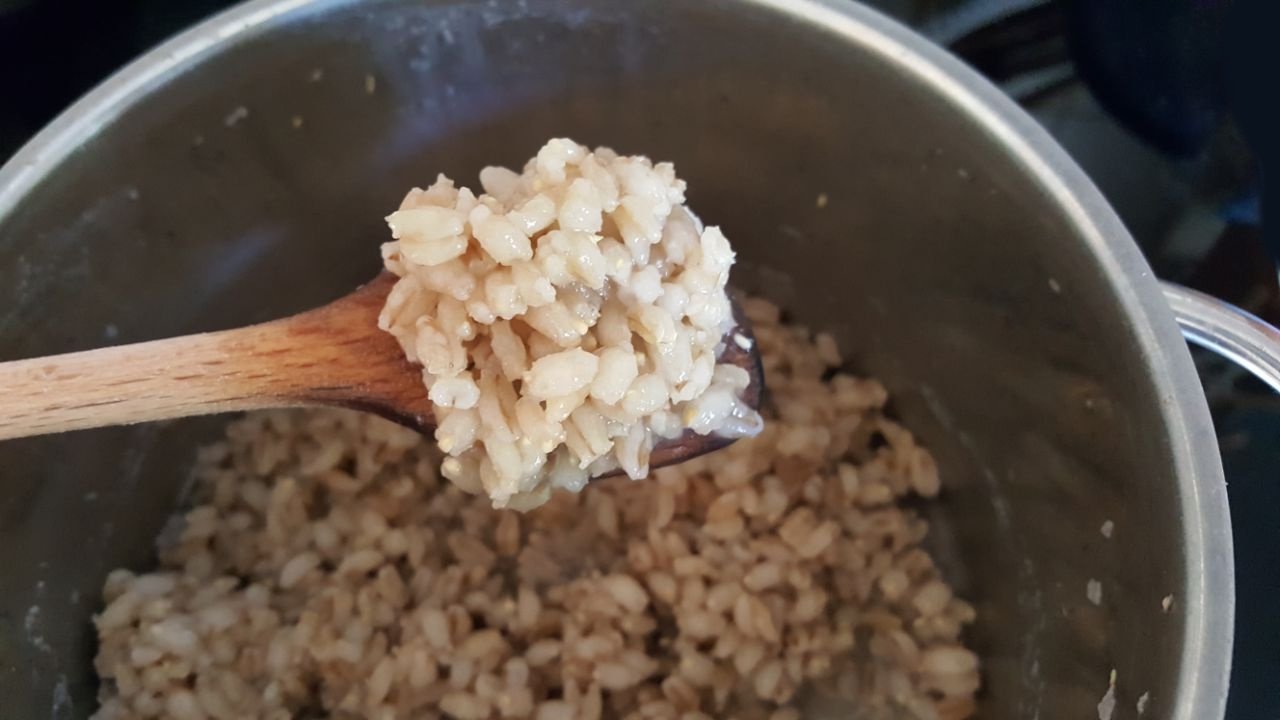
When the water first comes to a boil, the grain begins to foam. This foaming varies from grain to grain. For example, barley foam forms large bubbles and initially shimmers in rainbow colors, which could be an indication of the crystalline nature of silica. How much water the cook may need to add depends largely on the formation of mucilage, which should occur during the second cooking process. Only when the grain has fully swollen and the liquid in the pot becomes thick and slimy is the grain fully cooked. A texture resembling “grainy rice” is not desirable here, as it would impair digestibility.
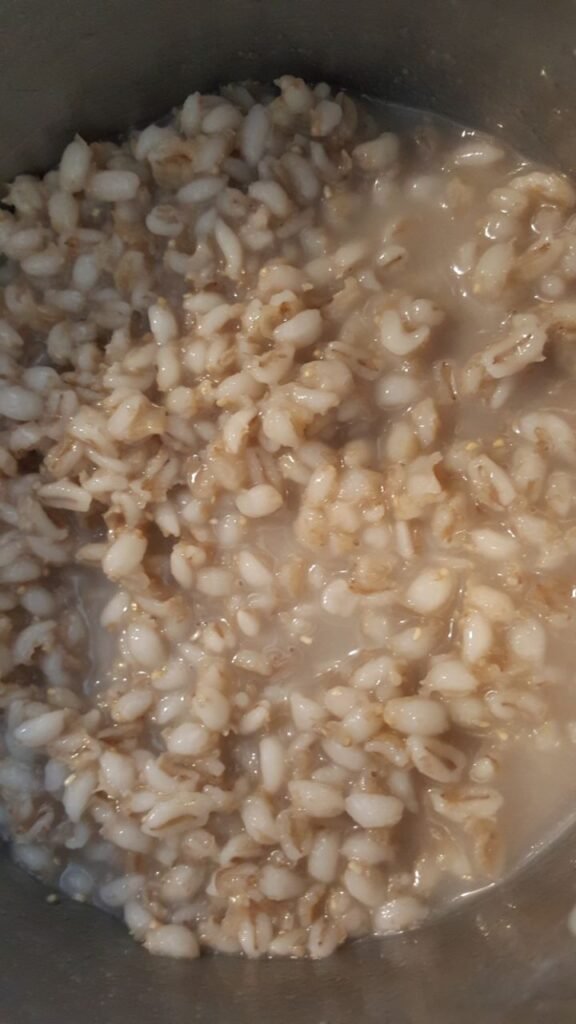
Cooked barley with the release of the mucilage beta-glucan
Varieties of Barley
Barley is one of the oldest grains in existence and is cultivated all over the world. Consequently, there is a wide variety of barley types available on the market. For example, there are two-row, four-row, and six-row varieties of barley. In so-called hulless barley, the husks fall off on their own during threshing. Today, hulless barley is grown almost exclusively in the organic sector.
Husked barley must be mechanically dehusked after threshing. In the process, the outer layers of the grain are usually damaged, and the grain loses its ability to germinate. The barley hulls are used separately as animal feed. The hulls are indigestible for humans. The commercial product is correctly referred to as hulled barley. Hulled barley also provides the barley malt used for brewing beer and for malt coffee.
So-called “pearl barley” consists of hulled and polished barley grains. Even without the outer husks, it remains a very healthy food, since valuable substances in barley—such as silica and the soluble dietary fiber beta-glucan—are found within the grain itself and not just in the husk.
How can we conduct our own research?
It is extremely helpful to go out into nature and actually observe a barley field—or at least to have an ear of barley at home.
Independent research begins with a question, such as, “How does the effect of emotional stability manifest in connection with barley, which has nothing to do with the material plane?”
You can hold onto such a question for a while—for example, while cooking. This often leads to further questions and also to initial answers that should be evaluated with caution. Furthermore, it is helpful to consult relevant texts, such as those addressing the concept of mental stability in general.
In this type of research, it is important not to rush to provide answers based on intellectual reasoning. Part of the learning process involves holding back the intellect with its hasty judgments, without, however, abandoning the act of thinking itself.
Of course, practical experiences—such as eating barley for three days—are also part of this research activity.
In the next video conference, we would like to further explore the question of the human role in the cooking process and also address issues regarding the quality and shelf life of grains, and barley in particular. “Every food begins to lose nutrients within one to two years after harvest. When stored in a cool, dark place, these oxidation processes occur more slowly.” (Sissy)
A wide variety of contributions on aspects of barley and grains are welcome.
Observation Exercise
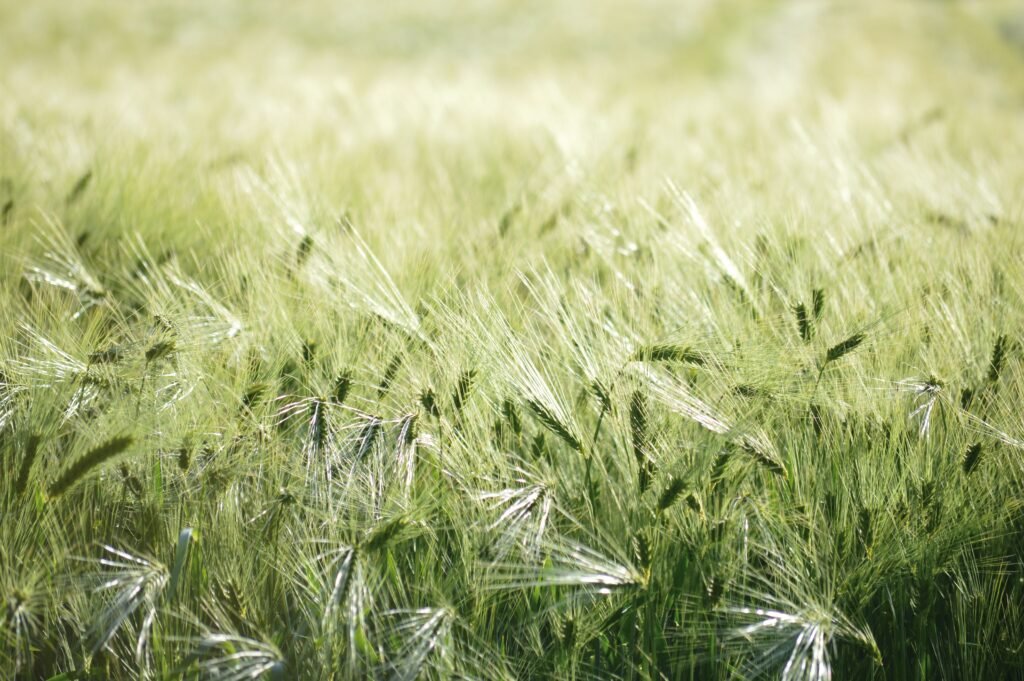
Look at the barley stalk shown in the image and mentally name the individual elements: Let your eyes glide along the ear, grain by grain, then along the awns as they attach to the so-called lemma and radiate outward. Observe the rounded shape of the grains and how the ear begins to tilt downward. What shades of color do you notice? Have you ever held a stalk of barley in your hand?
Anyone who has been fortunate enough to see a barley field swaying in the sun and the wind can draw on that memory for this contemplation. “A barley field shimmers differently than a rye field” (Maria).
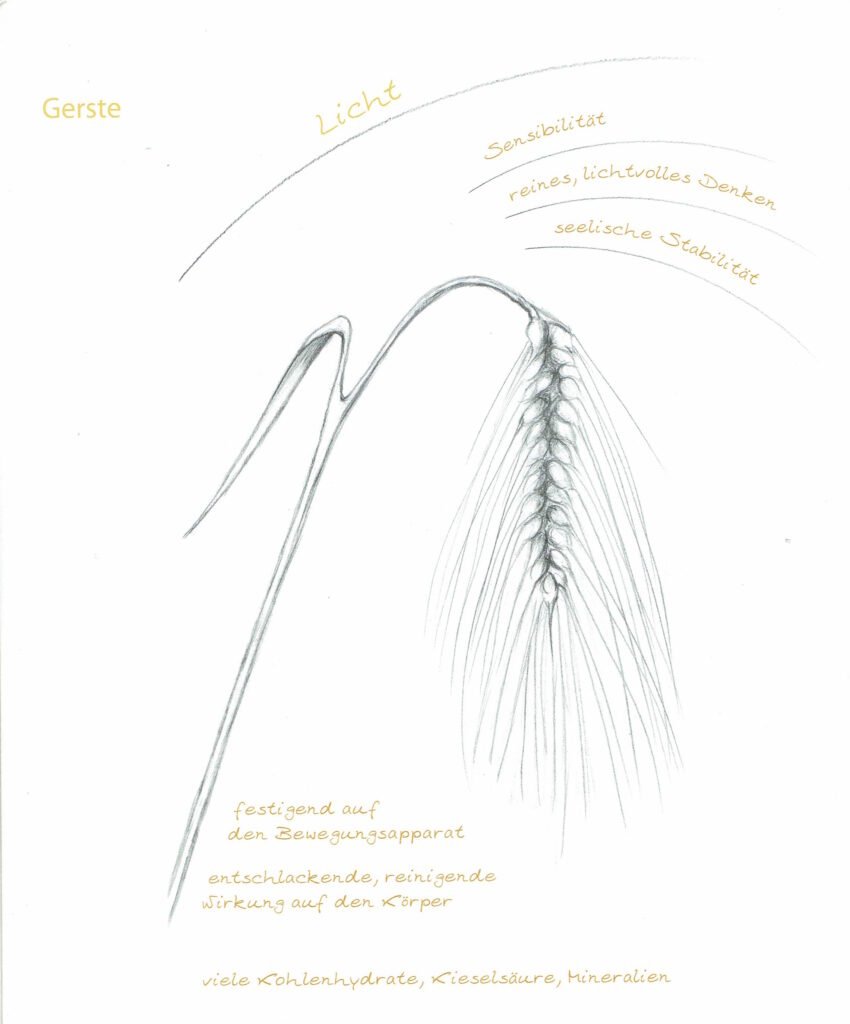
You can also use the meditation image from the book *Nutrition and the inner sense of Giving* by Heinz Grill for this contemplation exercise (see image below). Read carefully the various properties that barley exhibits on the material level (proteins, silicic acid…), on the emotional level (emotional stability…),
and on the spiritual level (light).
Then relax your eyes, leave them slightly open, and once again visualize the image of the
barley stalk, vividly reconstructing it in your field of vision. As you focus on this mentally constructed image, recall the properties of barley and keep your thoughts on it for a few minutes.
At the next video conference on August 21, 2026, we will continue to share and explore the latest findings on barley and its health benefits. Everyone is invited to join the research and rediscover barley as a food! To register for the video conference, please send an email to info@carmenkraus.com.