
Forum for Holistic Vegetarian Culinary Arts
Impulses for a New Culture of Nutrition
A guest post by Ursula Rütimann, December 2025
Nutrition
In several passages of the Bhagavad Gita, it is stated that our food arises from Brahman, the highest creative principle. In Indian philosophy, Brahman is understood as the great and sacred creator of all existence.
“In the beginning, together with the sacrifice, the Lord of all beings brought forth the creatures and said: Through this sacrifice you shall bring forth fruits and offspring. Let the sacrifice be the cow that yields the fulfillment of your desires.” Bhagavad Gita, Chapter 3/10
Other passages of the Bhagavad Gita also describe food as arising from Brahman, for example in
“From food all beings draw their life. From rain comes food. From sacrifice comes rain. Sacrifice is born of action. And know that all action has its origin in Brahman.” Bhagavad Gita, Chapters 3/14 and 3/15
From a simple perspective, we can see that food is understood in this scripture as part of a great sacred cycle. It is therefore not viewed in isolation nor merely as matter. It is indeed matter, yet matter that has arisen from light — condensed light, one might say.
The Situation in Today’s World
World Hunger
Sadly, there are many countries today in which people suffer from hunger. Due to war, drought, economic instability, and deliberate power strategies, 673 million people currently face hunger — 8.2% of the world’s population (World Food Report 2025). It is tragic that hunger has been used since the time of colonization up to the present day as a geopolitical and strategic tool to weaken nations, make them dependent on food supply chains, and thereby render them vulnerable.
Distribution an Organization of Food
This vast and complex topic can only be touched upon briefly here. The global distribution of food is shaped by a network of political forces and international organizations such as the WTO (World Trade Organization), FAO (Food and Agriculture Organization of the UN), and WFP (World Food Programme).
• The WFP provides direct logistical food assistance in crisis situations.
• The FAO works more strategically and consultatively, focusing on improving nutrition, especially in rural regions.
• UNICEF and various NGOs complement these efforts with targeted support for children and communities.ù
Global Food Corporations
Around the world, enormous multinational food companies shape supply chains:
United States
• ADM, Cargill, Bunge – agricultural trading giants moving grains and oilseeds globally
• PepsiCo – one of the world’s largest food and beverage corporations
• Coca-Cola – global leader in beverages
• Mondelēz International – confectionery and snacks
Europe
• Nestlé
• Danone
• Unilever
• among others
These corporations shape global supply chains and exert tremendous influence on food prices and availability.
Instruments of Power?
When we compare the brief overview of the global food market with the original idea of food as a sacred offering arising from Brahman, we sadly see how reverence and spiritual awareness have faded from humanity’s relationship to food over the centuries.
This modern view of food production and distribution reveals how food has become an instrument of power and manipulation. Exporting nations control large portions of agricultural production, and multinational agribusinesses such as Cargill, ADM, and Bunge determine the global flows of grains and soy.
Global Seeds
The global seed market is likewise controlled and dominated by a handful of large agribusiness corporations. The largest companies include Bayer, Corteva, the Syngenta Group, BASF, ChemChina, and others. The world market is highly concentrated in their hands. They also offer pesticides and fertilizers that are specifically adapted to their seeds. Farmers who wish to achieve good yields are therefore dependent on these products.
This concentration means that only a few companies determine which plants are cultivated, how much seed costs, and which agricultural methods become dominant.
Such a concentration of power has sparked movements for food sovereignty around the world. These movements promote seed networks that enable farmers and communities to bypass the agricultural giants. Their aim is to manage their own seeds under self‑determined conditions.
Which Paths Can Reduce World Hunger?
Contemporary and Healthy Approaches
There is a wide range of organic products available on the market. Among biodynamic products, the “Demeter” label is considered the highest quality. Based on the principles of Rudolf Steiner, it meets stricter standards than the EU organic regulations and emphasizes sustainability and circular Economy.
Locally and organically grown products are increasingly valued and purchased in Germany. In Switzerland, demand has stagnated. Consumers pay more attention to seasonality and origin rather than relying solely on organic labels. Vegetables and fruits purchased directly from a farmer’s shop — from a farmer one knows personally — are highly appreciated. Healthy, untreated vegetables and fresh fruits are in great demand. We may assume that people wish to be healthy and desire health for their families as well.
Ways to Reduce World Hunger from a Spiritual Perspective
Human beings are endowed with creative potential. Unlike animals, which take in food primarily to satisfy hunger and ensure the continuation of their species, humans are capable of forming a conscious relationship with food and of adding so‑called life forces to it through their thoughts. These forces, which are infused into natural foods before and during preparation, elevate and enrich the meal on the plate, transforming it into a healing nourishment.
Thoughts are essential forces from a spiritual dimension; thoughts are forces of light — thoughts are light.
Swami Sivananda (1887–1963), the great saint and Yoga master, emphasized that thoughts possess immense spiritual power, capable of exerting a profound influence on one’s surroundings and thus on the world. The creation and guidance of these invisible forces was a central concern of the Sivananda Yoga path.
The ability to create thoughts rests within our soul potential. The development of this consciousness‑force is an important task for humanity today and in the future. It is human thinking that lays the foundation for a new economic order. It is the individual who shapes the basis of the world order. As we think, so we build the future.
Creating Etheric Forces
What are Etheric Forces?
Etheric forces are freely flowing energies active in nature, invisible to the physical eye. They are described as cosmic forces and are essential for maintaining and promoting health. Etheric force refers to a living energy present in all living beings — in humans, plants, and animals.
Traditionally, four etheric forces are described: the fire or warmth ether, the light or air ether, the sound or chemical ether, and the life or vital ether. In the etheric body, these four forces work together — they are the carriers of life.
In plants, warmth ether and light ether work from the outside inward. Chemical ether and life ether work from the inside outward. The chemical ether is significant for the plant’s dynamic processes; it has the ability to contract and expand, thereby incorporating mineral substances into this movement. It is therefore essential for organic growth. The life ether also works from within outward, shaping the plant’s structure and growth. It is also responsible for the plant’s levity — its ability to rise upward against gravity.
Etheric forces are wise, ever‑moving energies. These natural forces operate within the laws of nature, which in turn are interwoven with the great cycles and rhythms of the harmony of the cosmos.
The Ideal of the Research Kitchen
In the ideal of the research kitchen in Lundo lives the intention to offer healing nourishment for human beings. One may even assume that the meals offered — through a method of preparation rooted in a spiritual approach — have therapeutic effects. Through the work of consciousness, food is elevated to a higher level. How can this healing force be created?
Expertise
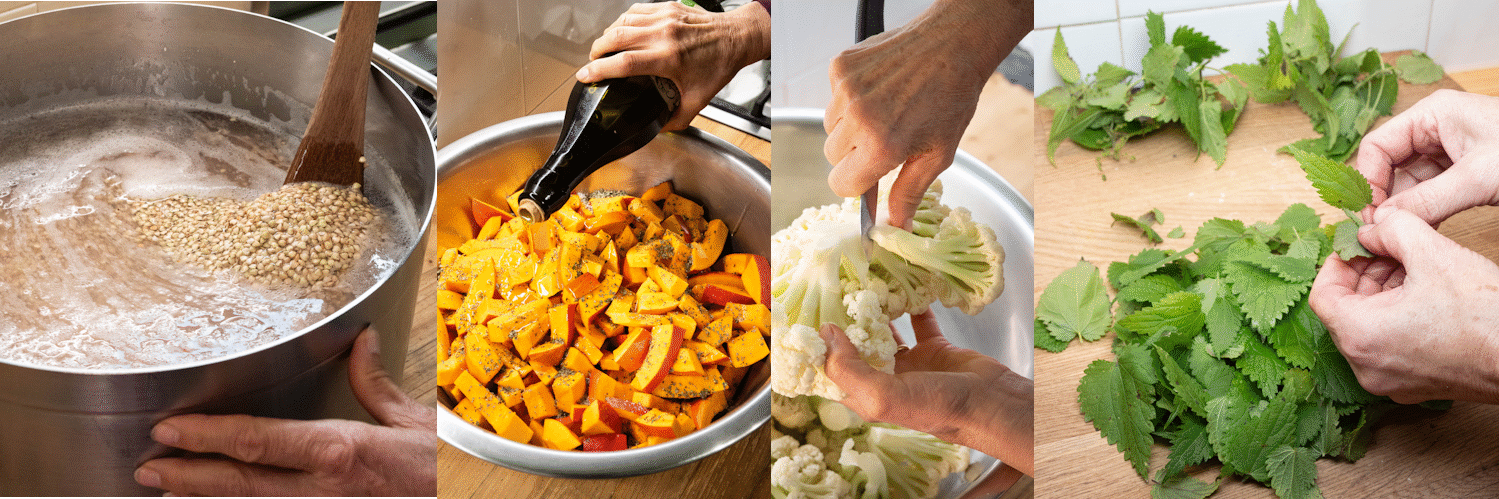
Expertise is a very important aspect of cooking. The person who cooks understands themselves as a researcher and learner. They explore the various foods and continually expand their knowledge. In the research kitchen, the main component of the meal is grain or buckwheat, complemented by suitable herbs and seasonal vegetables, and enriched with a source of protein (usually quark or buttermilk). Seasonal fruits or fermented vegetables are served alternately.
Through expertise, an inner relationship and sensitivity toward the different foods gradually develops. A quiet sense of gratitude toward the nourishment arises within.
Creating Warmth Ether
Before Cooking
To support a deeper understanding, the cooking process shall be described here in detail:
Before the preparation begins, the menu is formed in the memory of the kitchen staff as an ideal image. This image should arise vividly before the inner eye. The food, with its inherent qualities, the colours of the vegetables, their shapes before and after preparation — all of this requires a series of preparatory questions that are built up mentally. The method of preparation is then developed in thought: questions about the form of the trimmed vegetables are clarified, and the addition of spices is carefully considered.


Creating Light Ether
The Cooking Process
During cooking, attention is directed toward the process itself. Changes that arise through heat and transformation are observed with attentiveness and devotion, and the next steps are thoughtfully considered. The menus should not arise out of habit but be created anew each time. Cooking is guided by the principle that neither too much nor too little should be added. In this sense, cooking becomes an act of conscious engagement.
In Indian Yoga philosophy, the idea of “not too much and not too little” corresponds to the nature of Sattva, one of the three Gunas. The Gunas, described in Samkhya philosophy, represent the qualities of Prakriti (primordial matter). Samkhya distinguishes three Gunas: tamas (inertia, rest), rajas (drive, impulse, activity), and sattva, which is described as clarity, light, insight, harmony, and goodness. Sattva is the balancing principle between inertia and restlessness — a qualitative middle, a living heart‑center that transcends both forces.
The Attitude of the Person Cooking
Cooking takes place in a concentrated inner posture. The process is accompanied with attentiveness, and the ideal image of the meal is held before the inner eye. The ideal form of the dish is maintained in memory throughout the preparation.
Equally important is the orientation toward the people for whom the meal is being prepared. What do the diners need? With such questions, the staff directs their attention toward the eaters, seeking to understand their situation and to contribute something right and healing through the preparation of the food. What the cook places into the process — inwardly and in thought — will be received by the diners in a subtle, fine‑energetic way. Understanding these connections means cooking responsibly.
The inner attitude of the cook is grounded in sattva and, from this foundation, exerts a healing influence on their activity.
The productive activity of cooking, combined with the wish to create a healing cuisine rooted in the harmonious interplay of the ingredients, fills the cook with quiet joy.
Each act of cooking is carried out with the awareness of creating something new. Routine and habit should be recognized and avoided as much as possible. Creativity and a spirit of inquiry take their place.
Aesthetics
Another important aspect is the aesthetic quality of the kitchen. The kitchen should be clean and orderly. Everything has its place. Unnecessary items take up space and hinder a practical and clear workflow.
Purchasing Food
When purchasing food, attention is given to high‑
quality products, preferably from local sources. Organic products are preferred. It is valuable to know the origin of the food and, if possible, to build a relationship with the producer —
whether it is the farmer who grows vegetables and fruits or the staff of a local food shop. The work of the producer is seen and appreciated. Building relationships with producers creates trust in the product, and it is certainly meaningful for the producer to experience the appreciation of their customers. In this way, the research kitchen contributes a cultural value to the food chain.
Cooking as a Process of Inquiry
Cooking, carried out with this lively spiritual engagement, becomes a mental and exploratory process. The introduction of spiritual forces — living thoughts — refines and elevates the practice of cooking. Menus are tested, improved, and varied. This mental process trains imagination and concentration, and through perseverance and repetition, the soul forces of thinking, feeling, and willing are strengthened.
Why is this a Path toward reducing World Hunger?
It is through this creative process — through the building of etheric forces — that the space is strengthened in a substantial way. The environment perceives this strengthening, and the force radiates outward into the universe. The atmosphere is uplifted.
Heinz Grill writes in his Annual Outlook 2025, Part 4 (www.heinz-grill.de):
“To perceive this sphere of influence, one must apply a deeper perception with a relatively high degree of spiritual clairvoyance in order to recognize the significance of this movement of study and its content. None of these efforts follow a closed, self‑contained center; rather, they support the development of the entire world. Yet this does not occur directly, as if they were emitting a radiant energy, but they let spiritual forces drip, in a mysterious way, toward other nations and other people — sometimes even to far‑distant countries.”
The Research Kitchen and Heinz Grill, Spiritual Teacher
Heinz Grill is a remarkable figure and a source of inspiration. In addition to developing the “New Yoga Will,” he tirelessly researches various fields such as nutrition, architecture, pedagogy and education, health, and medicine. His perspectives are forward‑looking and peace‑building.
Further Reading
Nutrition and the inner Sense of Giving – The Spiritual Meaning of Food, Heinz Grill, Stephan Wunderlich Verlag
Licht- und Wärmekräfte in Mensch und Natur, Heinz Grill, Stephan Wunderlich Verlag, ISBN 978-3-9815855-7-5 (only in German)
Die Milchsäure und ihre Bedeutung für die Gesundheit, Heinz Grill, Stephan Wunderlich Verlag, ISBN 978-9817200-1-3 (only in German)
Die vier Äther im Brot, Das übersinnliche Erfassen der vier Äther im Brot, Stephan Wunderlich Verlag, ISBN 9 783941 995864 (only in German)